How Stolen Vehicle Recovery Actually Works When Thieves Hack Cars
How Stolen Vehicle Recovery Actually Works When Thieves Hack Cars
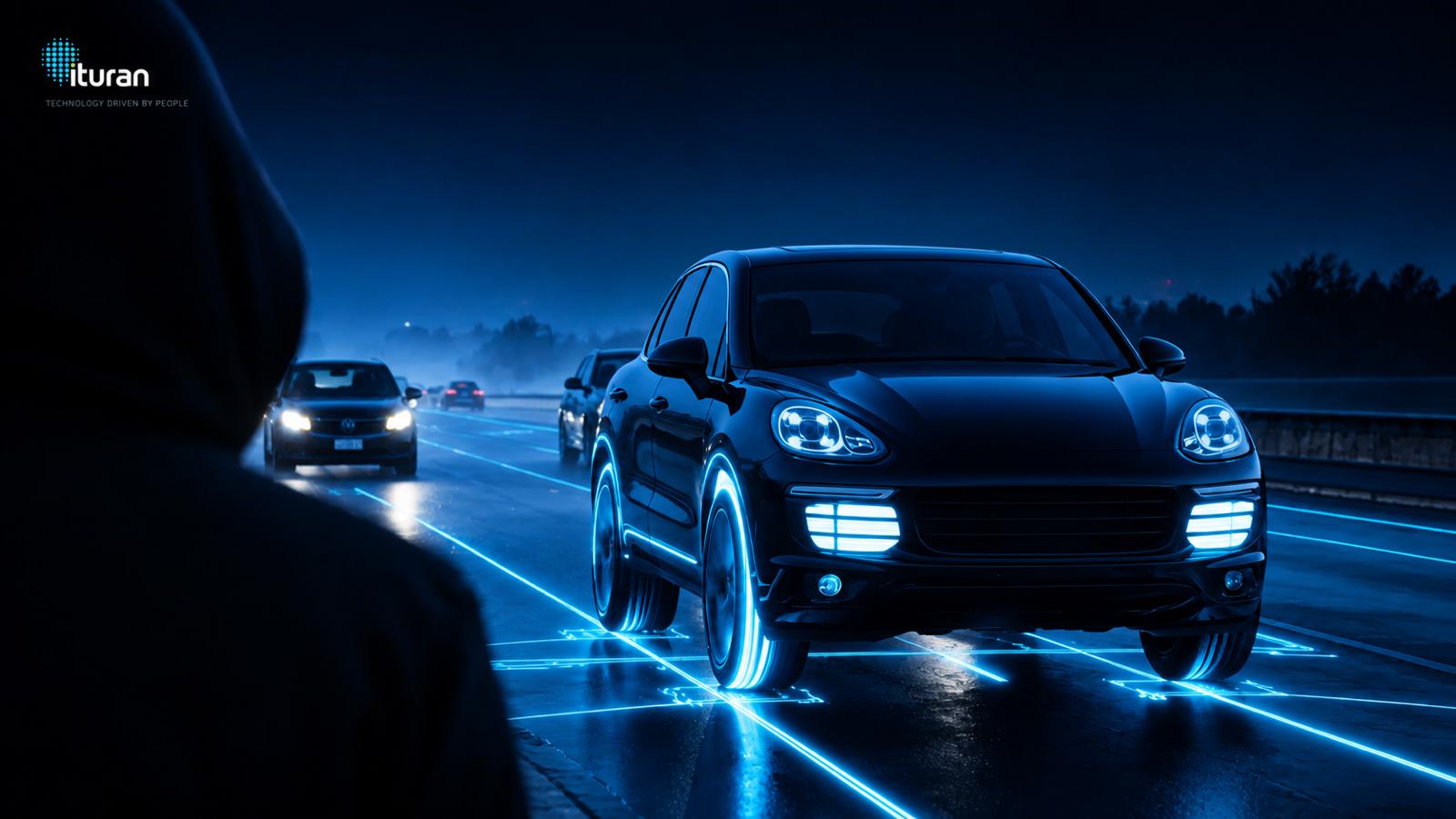
It is 2 a.m. on a rain-slicked street, and the most dangerous person near your vehicle is not holding a crowbar. They are holding a small black box.
Today’s professional car thieves do not break in. They hack in. A hand opens the driver-side panel, clicks a device into the diagnostic port, and within seconds the dashboard flickers and surrenders. No alarm sounds. No glass breaks. The vehicle’s own computer has been convinced that the thief is the owner. By the time anyone notices, the car is already three highways away and headed for a chop shop, a shipping container, or a resale market in another country.
This is the new economics of vehicle theft. Professional organized crime networks now dominate, relying on OBD-port hacking, relay attacks that clone key fob signals, and stolen-key scenarios in which vehicles are driven away with fully legitimate credentials. Against this kind of adversary, traditional recovery odds remain poor. Without specialist stolen-vehicle-recovery technology, only 10 to 20 percent of stolen vehicles are ever recovered, and many of those that return are stripped or damaged.
Understanding how that number can be inverted, how a stolen vehicle can be back in its owner’s hands, intact, in under an hour, requires looking past the idea of a simple tracker. What actually works is a system. The clearest example of that system operating at scale is Ituran, a company that has spent three decades building it.
“Today’s car thieves do not break in. They hack in, and the recovery rate for a hacked vehicle, without specialist technology, is barely one in five.”
The New Reality of Vehicle Theft
The first thing to understand is that effective recovery does not start when a car goes missing. It starts at the point of attack, in the milliseconds when the criminal is interacting with the vehicle’s electronics.
The In-Vehicle Shield That Actually Fights Back
Ituran’s answer is proprietary in-vehicle hardware called Cyber-CAN that sits directly in the vehicle’s CAN-bus pathway. Unlike a passive aftermarket tracker that merely reports location after the fact, Cyber-CAN continuously listens to the bus and learns normal command patterns. The moment it detects command sequences typical of an OBD or relay attack, it sends targeted disruption commands to neutralize the malicious activity without affecting the vehicle’s own systems, while instantly transmitting an encrypted alert to Ituran’s control infrastructure.
The attack that was supposed to be silent and instantaneous instead triggers an immediate, coordinated response. Electronic detection at the vehicle level sends an encrypted alert to the control center, which rapidly mobilizes recovery resources exactly when the criminal’s window for a clean getaway is smallest.
This purpose-built hardware does something no software layer bolted on afterward can replicate. It turns the vehicle’s own electronics into an active participant in its own defense rather than a passive target. That single capability is the foundation on which the rest of the system is built.
Intelligence Built on 30 Years of Real Recoveries
Hardware alone would drown operators in noise. With more than one million monitored vehicles in Israel alone and a global base now exceeding 2.6 million across more than twenty countries, Ituran’s network generates up to 500,000 alerts in a single day. The overwhelming majority are benign: a legitimate diagnostic session at a dealership, an owner’s unusual but innocent route, or a sensor quirk. What separates Ituran is not the volume of signals, but the intelligence that filters them. Advanced AI, trained on three decades of real-world recoveries, rapidly narrows the daily flood from 500,000 alerts down to approximately 15,000 high-risk threats, and then to just a few hundred confirmed real events requiring human verification and potential field response. This dramatic reduction, from half a million raw signals to a few hundred actionable incidents every day, is the operational heart of the system. It turns an otherwise unmanageable torrent of data into precise, timely intelligence that enables recoveries often before the owner even knows the vehicle is gone.
This is where data becomes the moat. Ituran’s AI does not score alerts against generic rules. It scores them against thirty years of accumulated recovery experience, what real thefts actually look like in the field, learned from a company founded in 1995. The system sweeps the daily flood of alerts and dims the noise until only genuine anomalies remain illuminated.
The most telling case is the stolen-key theft, the scenario that defeats almost every other defense. The vehicle is driven away with valid credentials. Nothing is forced. Nothing appears obviously wrong. Yet a driver who is not the owner behaves differently in ways too subtle for a human to catch but unmistakable to a model trained on three decades of behavioral signatures. A deviation in route logic, timing, or driving pattern surfaces against the owner’s established baseline. The thief drives normally. The car behaves normally. The data does not.
“The thief drives normally. The car behaves normally. The data does not.”
The Human Layer No Algorithm Can Replace
Intelligence only matters if it ends in a physical outcome, and this is the layer that most cleanly separates a full-stack operator from a pure-technology vendor. A verified threat does not generate an email. It triggers a human response.
Inside Ituran’s 24/7 National Control Center, every real alert is verified by a trained operator before anything moves. This critical filter protects against false dispatches that would erode trust and waste resources. Once confirmed, the system coordinates the dispatch of skilled field agents who work hand-in-hand with police. Combining satellite and cellular tracking with remote vehicle capabilities and ground teams who know how recoveries actually unfold, the operation closes the distance between a data point on a screen and a hand on a car door. This is the part of the chain that cannot be downloaded. It rests on roughly 2,800 employees worldwide, decades of police relationships, and operational muscle built recovery by recovery.
Why Only a Full-Stack Operator Can Deliver 80 Percent Recovery
Put the three layers together and the numbers tell the story. Ituran achieves an average recovery rate of roughly 80 percent, more than four times the 10 to 20 percent typical of stolen vehicles without specialist SVR technology. Recoveries usually happen in under 60 minutes. In many cases the vehicle is back before the owner even realizes it was gone. Since 2006 the company has recovered more than 200,000 vehicles worth over 3 billion dollars, with 2024 recoveries alone totaling roughly 300 million dollars.
Stat callout: 80 percent recovery rate · 4 times the industry average · Under 60 minutes to recovery · More than 3 billion dollars recovered since 2006
The strategic insight for investors, insurers, and fleet operators is that this result is possible only because Ituran owns every link in the chain. Hardware in the vehicle generates the raw signals. Thirty years of recovery data trains the AI to separate signal from noise. Verified threats trigger a 24/7 control center and skilled field agents who work directly with police. Each successful recovery feeds better behavioral data back into the model.
The advantage compounds in a self-reinforcing loop. More vehicles in the field produce richer real-world data. Sharper AI improves operational precision. Higher recovery rates build customer trust and market share. Successful outcomes generate still better training data. Fragmented competitors cannot replicate this flywheel. A pure-software player can analyze alerts but cannot defend the CAN bus or put an agent at the scene. A pure-hardware vendor lacks the decades-deep behavioral dataset and coordinated ground response. The result is not incremental improvement. It is a structural moat that directly degrades the economics of organized theft.
When a stolen vehicle is recovered four times out of five, usually within the hour and often before a fence can be reached, the entire business model of organized theft degrades. The expected value of stealing a protected car collapses. For insurers, that translates directly into lower loss ratios and a defensible case for premium differentiation. For fleet operators, it means materially lower risk on high-value assets. For the connected-mobility sector broadly, it offers a working template for what vehicle security looks like when the threat is a network of hackers rather than a man with a slim jim.
“The same platform that protects vehicles at scale is also building the data foundation for the next generation of mobility services.”
The category Ituran occupies is best understood not as tracking but as critical infrastructure for a world where the car is a computer and that computer is under constant attack. The same vertically integrated platform that delivers an 80 percent recovery rate also generates rich, real-time behavioral and operational data at scale. As connected mobility and vehicle intelligence continue to evolve, this foundation creates a natural pathway to expand beyond traditional recovery into higher-value data and AI-driven services.
The companies that win in this environment will be those that own every link from the diagnostic port all the way to coordinated field response. And can turn that control into actionable intelligence for customers, insurers, and fleet operators.
Peace of mind, in this business, is not a feature. It is engineered end to end.


 Follow Us
 Follow Us
 IS
IS US
US BR
BR MX
MX AR
AR