The Best New Business Is Built on Assets You Already Own

What Ituran’s first multi-year Big Data contract with Israel’s Ministry of Transport reveals about where the company is going
For thirty years, Ituran has built a network to do one thing exceptionally well: find stolen vehicles and return them to their owners. More than 200,000 vehicles recovered. Over US$3 billion in vehicles returned. A recovery rate near 80 percent in an industry where the average is far lower. This week, we announced a second use for that network, and a new business built on it.
Ituran has signed a multi-year commercial contract with entities of Israel’s Ministry of Transport to provide a Software-as-a-Service platform that monitors live traffic across Israel’s main roads. The agreement runs for up to four years and is valued at more than NIS 21 million (approximately US$7 million). The first year, worth NIS 5 million (approximately US$1.7 million), is guaranteed.
The platform combines anonymized data from more than one million vehicles, approximately one quarter of those on Israel’s roads, with Ituran’s technology and AI to process traffic behavior at national scale and translate it into decision-ready insight. The Ministry’s entities will use the resulting insights to inform national transport policy and future road investment. This is our first multi-year commercial contract under the Big Data initiative. It follows an initial project announced with our first-quarter results, which analyzed where truck accidents occur to help determine where rest areas should be built.
A promise from my last article
In my last article, I described how modern stolen vehicle recovery works: why hardware alone is not enough, and how an integrated system filters half a million daily alerts down to the few hundred that matter. I ended with a claim about the future: the data foundation beneath our recovery business would allow us to expand into higher-value services across connected mobility.
This contract is the first commercial evidence of that claim. It is neither a pilot nor a partnership announcement. It is a government customer paying recurring fees under a multi-year contract for insight that only our network can produce.
One integrated model, extended further
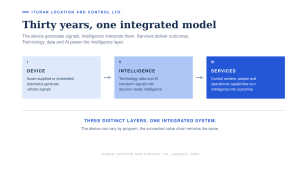
Ituran’s model has always integrated three linked layers: Device, Intelligence and Services. The device generates the signals. Technology, data and AI turn those signals into intelligence. Our services, delivered through control centers, people and operational capabilities, turn that intelligence into outcomes: a verified alert, a coordinated field response and, often, a recovery completed in under an hour.
The role of the device can vary by program. In some cases, we provide the telematics unit ourselves; in others, we can work with technology already embedded in the vehicle. The model supports both. What remains constant is our ability to connect the device layer with our intelligence and services to provide a complete solution. As factory-installed telematics becomes more common, that flexibility allows our role to evolve while preserving the value we provide.
Big Data extends the same model. Recovery means studying one vehicle behaving abnormally; transport policy means studying a million vehicles behaving normally. In both cases, devices generate signals; technology, data and AI transform them into intelligence; and services deliver that intelligence in a form customers can use. We built the recovery business deliberately over three decades. The potential to use the network for new services was accumulating quietly all along.
Why this contract matters more than its size
Relative to Ituran’s annual revenue, this contract is modest, and we have been transparent about that. Judged by what it establishes, however, it is among the most significant agreements we have signed. Here is why.
First, it creates an entirely new way to monetize assets we already own. The asset is not the database alone. It is the integrated combination of a large connected installed base, technology, data, AI and service capabilities that allows us to process movement at national scale and deliver decision-ready insight. Without those capabilities, we could not provide this offering. The data is already collected, the infrastructure built, and the costs absorbed by our core subscription business. As a result, this revenue requires very little incremental investment. These are the economics every finance executive looks for and rarely finds.
Second, it is recurring, multi-year business-to-business revenue from an institutional customer, the first contract of its kind in our history. It does not depend on adding a single subscriber. Our subscription business grows with the number of vehicles under service; this business grows with the value of understanding how they move together. Two engines, one network.
Third, it gives us a demanding reference customer. A national ministry does not rely on a supplier’s view of its road network lightly. It selects data and technology it trusts to inform decisions with national consequences.
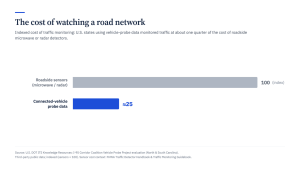
The economics for governments are equally compelling. When U.S. states evaluated vehicle-probe data against traditional roadside detectors, they found it delivered traffic monitoring at roughly one quarter of the cost. A roadside sensor must be installed and maintained indefinitely, and it sees only the point where it stands. A connected-vehicle platform sees the network.
What the platform sees, and what it never sees
Precision builds trust, so let me be clear. The platform does not track individuals. It delivers aggregated, anonymized, macro-level insight into traffic and driver behavior across a national road network. Its value to the Ministry’s entities is the whole picture, not any single vehicle within it: where to invest, how to make roads safer, and how the country will commute a decade from now. In the recovery business, we protect one owner at a time. In this business, the same network serves everyone on the road at once.
A first contract, not a final destination
Big Data is one of three strategic initiatives we set out for 2026. The others are IturanMob, our shared-mobility management platform recently launched in the United States, and our carbon-credit platform for electric vehicle drivers.
How large could this become? I will not claim a precision nobody has. Third-party forecasts of the vehicle-data market vary widely in scope and size, but they agree on two points that matter: the market is growing at double-digit rates, and governments and infrastructure operators are its fastest-growing group of buyers. McKinsey estimated in 2016 that car-data monetization could represent as much as a US$750 billion global revenue pool by 2030. Whatever the exact number proves to be, the direction is not in dispute.
I prefer arithmetic an investor can check: one ministry, in one country, is worth more than NIS 21 million to us over four years. Ituran serves customers in more than 20 countries, with networks already operating at national scale in Brazil and Mexico. We are not projecting how many similar contracts we will sign. The point is simpler: the first one exists, and it was not designed to be the last.
The opportunity extends beyond one ministry. As we have said publicly, the same capabilities can serve transport authorities, commercial centers, OEMs, and the insurers and vehicle importers we already serve through our core business. We have deliberately started in Israel. The plan we described in August is to prove the model at home, then take it to markets where our data already lives.
The most interesting question is no longer whether Ituran’s data has value beyond recovering vehicles. A national ministry has answered that. The question now is how many more customers, and how many more countries, will ask it next.
Questions investors are asking
What did Ituran announce?
Ituran Location and Control Ltd. (Nasdaq: ITRN) has signed its first multi-year commercial contract under its Big Data initiative. The company will provide entities of Israel’s Ministry of Transport with a Software-as-a-Service platform that monitors live traffic across Israel’s main roads. The agreement runs for up to four years and is valued at more than NIS 21 million (approximately US$7 million). The first year, worth NIS 5 million (approximately US$1.7 million), is guaranteed.
Does the platform track individual vehicles or drivers?
No. The platform delivers aggregated, anonymized, macro-level insight into traffic and driver behavior, drawn from more than one million vehicles, approximately one quarter of those on Israel’s roads. Its value lies in the complete picture of the road network, not any single vehicle within it.
How does Ituran make money from vehicle data?
The data is already collected through Ituran’s core telematics and stolen-vehicle-recovery services, and the infrastructure is already built. The offering, however, depends on the full chain: the connected installed base generates the signals; Ituran’s technology, data and AI turn them into intelligence; and its services deliver decision-ready insight. Big Data contracts monetize aggregated, anonymized insights from that existing network as recurring, subscription-style revenue from institutional customers. This revenue does not depend on adding individual subscribers.
Is this Ituran’s first Big Data project?
It is the first multi-year commercial contract under the Big Data initiative. It follows an initial project completed for the Ministry earlier in 2026, which Ituran discussed with its first-quarter results.
Where does Big Data fit in Ituran’s strategy?
Big Data is one of three growth initiatives Ituran set out for 2026, alongside IturanMob, a shared-mobility management platform recently launched in the United States, and its platform for monetizing carbon credits for electric vehicle drivers.


 Follow Us
 Follow Us
 IS
IS US
US BR
BR MX
MX AR
AR